 DDungDDang Family
After Reading Rainer Maria Rilke's 《I Am Living My Life》
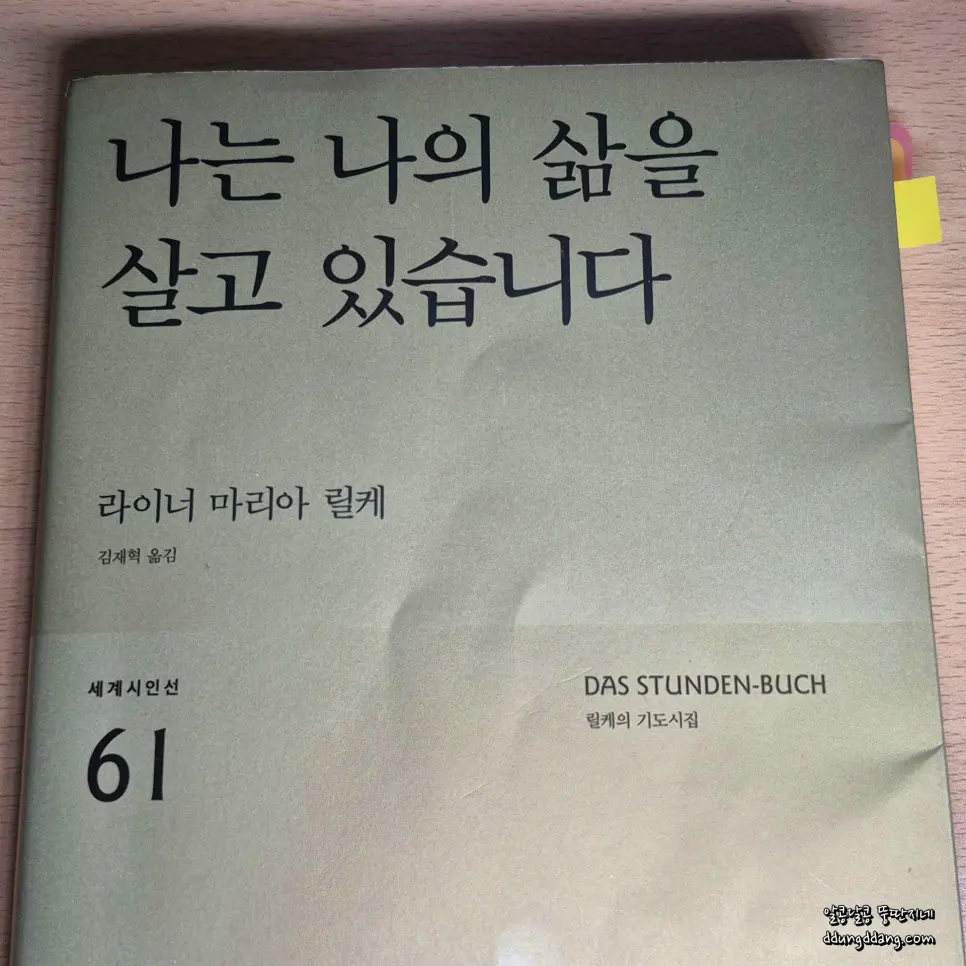
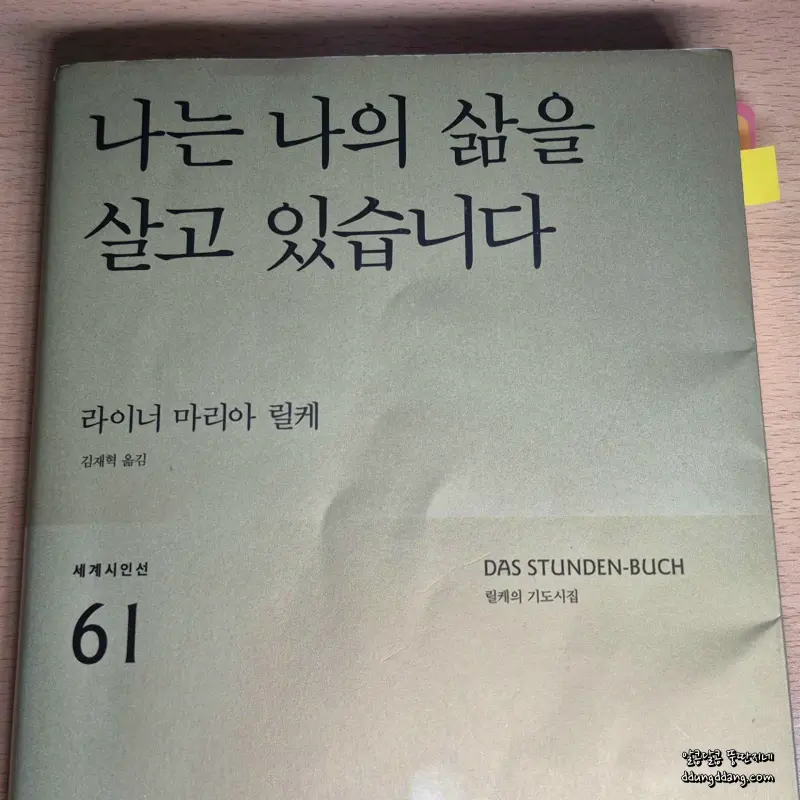
Hello? This is the Ddungddang family. This time I read Rainer Maria Rilke's 'I Am Living My Life'. Rainer Maria Rilke was an Austrian-German-language poet born in Prague in 1875 and who ended his life in Switzerland in 1926. He is well known for his delicate, thoughtful poetic world, and his major works include 《Duino Elegies》 and 《Sonnets to Orpheus》. 《I Am Living My Life》, which I read this time, is a book based on Rilke's 《Book of Hours (Das Stunden-Buch)》, and is introduced as an important work representing Rilke's early poetic world
Hello?
This is the Ddungddang family.
I Am Living My Life: Rilke’s Book of Hours — RainerMariaRilke2025Minumsa
This time I read Rainer Maria Rilke's 'I Am Living My Life'.
Rainer Maria Rilke was an Austrian-German-language poet born in Prague in 1875 and who ended his life in Switzerland in 1926.
He is well known for his delicate, thoughtful poetic world, and his major works include 《Duino Elegies》 and 《Sonnets to Orpheus》.
《I Am Living My Life》, which I read this time, is a book based on Rilke's 《Book of Hours (Das Stunden-Buch)》,
and is introduced as an important work representing Rilke's early poetic world.
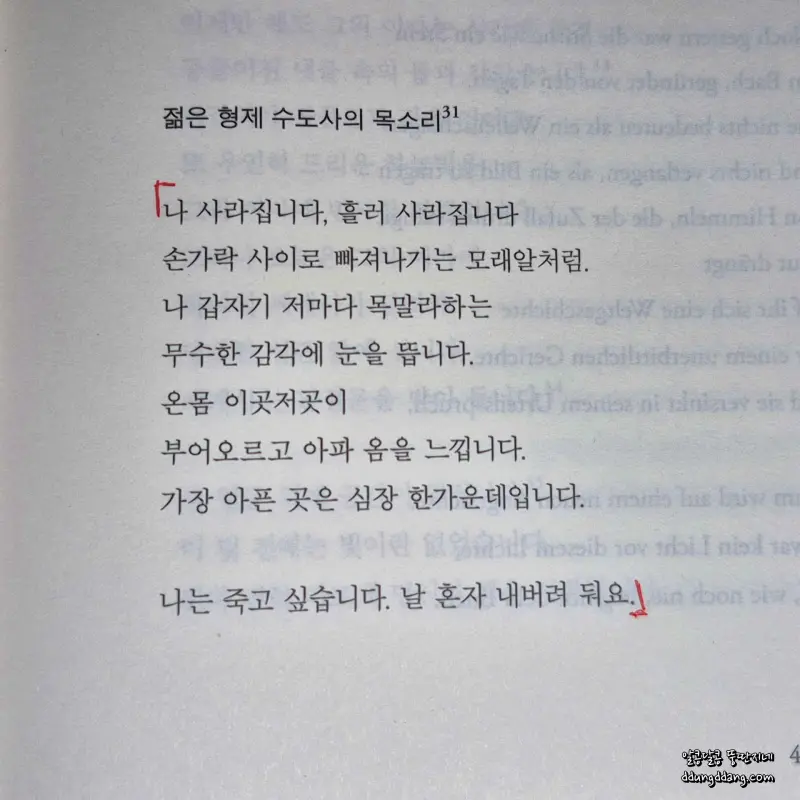
Starting with the sentence “I disappear,” it moves on to bodily pain and an aching heart,
and even to the wish to be alone — it had the power to strike directly at the reader's emotions.
Passages like this come across as painful rather than comfortable, yet strangely that honesty comforts you even more.
Because when things are hard, sometimes a sentence that states the sorrow as it is reaches the heart more than words pretending everything is fine.
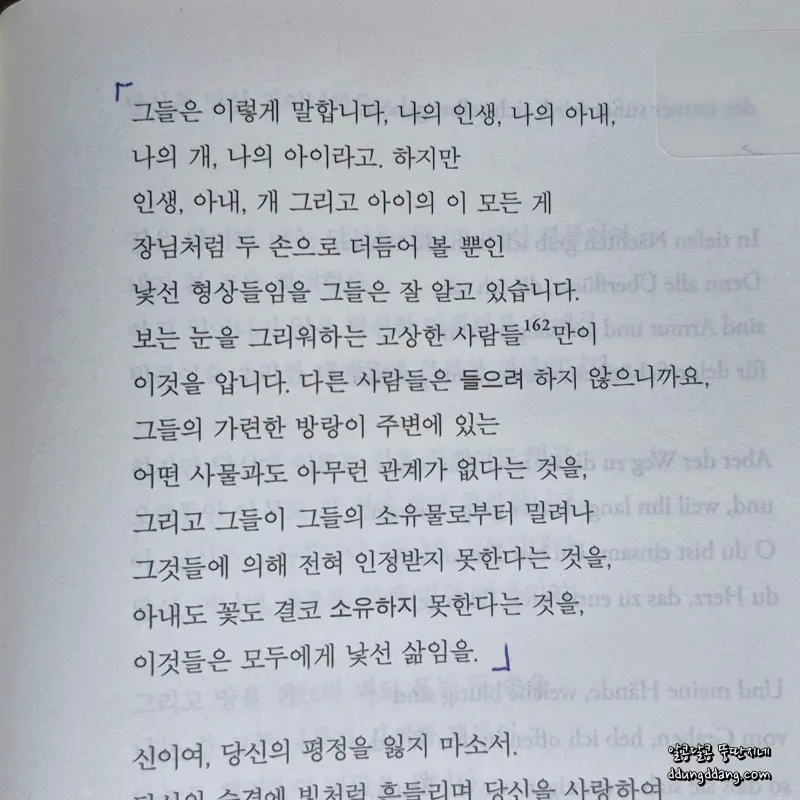
It was a story about how life, a wife, a dog, a child — the things we call 'mine' — may in fact be unfamiliar shapes we can never fully possess.
Rilke expressed that as "unfamiliar forms you only grope at with both hands like a blind man," and it stayed with me strangely when I first read it.
And then it suddenly occurred to me that our lives may be closer to 'receiving' than to 'holding on'.
Honestly, it's a lonely fact that people, relationships, and time can't be held the way I want.
But facing that loneliness, the Buddhist words impermanence (無常) and no-self (無我) suddenly came to mind.
That all things constantly change and never stay,
that there is no fixed substance anywhere called 'me' or 'mine',
and that therefore the more you cling, the more you suffer.
I thought the landscape of Rilke's unfamiliar shapes isn't so different from that path of reflection.
What's really curious about this passage, though, is that it doesn't end there.
Knowing that you can't hold on also means, conversely, that 'you come to feel the meaning of preciousness again'.
In the very moment you realize you couldn't hold on, the 'preciousness' inside it seems to show itself all the more vividly.
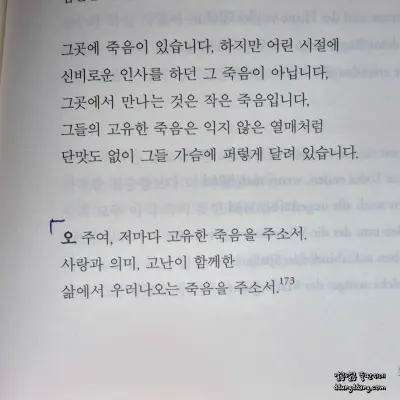
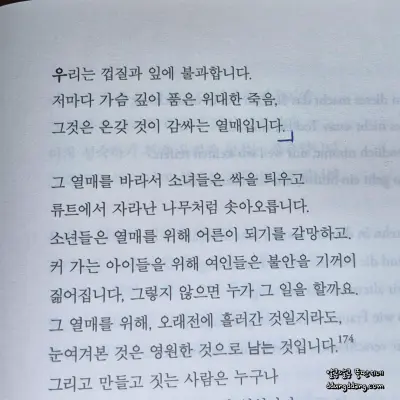
“O Lord, give each of us our own death.”
When I first came across this passage, my heart strangely stopped for a moment.
Before the word death, fear usually comes first, but the death Rilke speaks of had a slightly different texture.
He portrays it not as a fearsome 'end', but as 'each one's own death' that wells up at the end of a life shared with love, meaning, and hardship.
Simply put, the meaning of death changes depending on how you lived.
Even though it's a vague and heavy subject, the reason it strangely makes you solemn is probably that.
What especially struck me was the part where Rilke compares this 'great death' to fruit.
Fruit becomes fruit only after the seed is sown, grows, blossoms, and slowly ripens.
Seen that way, death isn't so much a sudden event,
as fruit slowly ripening through one's own life.
So that prayer, "give each of us our own death,"
ultimately felt like a longing for a well-ripened death,
for death as the fruit of one's own life.
Depending on what kind of life you lived,
depending on what kind of love you held,
the shape of that quietly ripening fruit will differ too.
I'm still far short of calling myself the end of a long, solid journey,
but still, the thought quietly remained that I want to keep the meaning of that 'ripening fruit' in my heart.
This is not a book that comforts in an easy, friendly way.
But that's exactly why it stayed with me even more.
Rather than brightly telling you that you're fine, it was a book that lets you quietly look at emotions like sorrow and anxiety, life and death.
For me personally, it's a book that remained especially memorable because I read it during a difficult time.
Just as listening to a sad song when you're sad helps you slowly collect yourself, this collection gave me strength in that way too.
It's not a book you read lightly, but for those who need quiet comfort, it seems it will hand over sentences that stay with you for a long time.
#RainerMariaRilke #IAmLivingMyLife #BookOfHours #DasStundenBuch #PoetryCollectionRecommendation #ReadingLog #BookReview #LifeAndDeath #AComfortingBook #Rilke